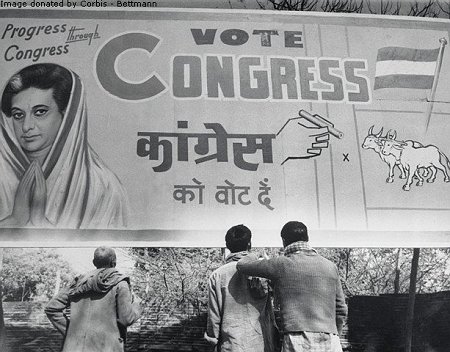
Congress (Indira), wearing the mask of a Pre Independence Indian National Congress
Are the claims of today’s (Indira) Congress that they are the same Congress which led the freedom struggle really valid? When we remove the veil that hides the history of today’s (Indira) Congress, the truth comes to light, and the difference between the old Indian National Congress and today’s Indira Congress becomes crystal clear. — Mahadevyya Karadalli
Preface
Having abandoned Dharma (righteousness) and ethics, the present-day Congress (Indira Congress) shamelessly claims to be the legal heir of the Congress that once fought for India’s freedom. Whether knowingly or unknowingly, they keep chanting 24x7 the name “Congress”. Today’s (Indira) Congress leaders boast that they are the inheritors of the Congress that led the freedom struggle. One can recall the famous dasaru (saint-poet) song Enta Lokavayya, noduvantillavayya, janara manasugalu badala guttiveyya, dharma neeti bitdu durâse hididavayya, satya-sullu gottâgada kâlavayya, enta lokavayya? (“Oh, what a world this has become! People’s hearts have changed, righteousness is gone, greed has taken over, truth and falsehood are indistinguishable… what a world, indeed!”) When we listen to the words of present-day Congress leaders. The song becomes a live example. So, what is the truth? Are the claims of today’s (Indira) Congress that they are the same Congress which led the freedom struggle really valid? When we remove the veil that hides the history of today’s (Indira) Congress, the truth comes to light, and the difference between the old Indian National Congress and today’s Indira Congress becomes crystal clear.
History of the Indian National Congress under Mahatma Gandhi’s Leadership:
The Indian National Congress was founded on December 28, 1885, in the hall of Gokuldas Tejpal Sanskrit College, Bombay (Mumbai) by a retired British civil servant A.O. Hume. The purpose was to create a national platform where Indian leaders could communicate with the British government and resolve grievances peacefully through dialogue and negotiation.
The Britishers through this “Congress,” created a safety valve to release the growing pressure of nationalist sentiment. And to prevent an explosion of revolution. The first president of the Congress was Womesh Chander Bannerjee.
However, within a short time, the Congress transformed from a mere political forum into a national movement of patriots determined to end British rule and win India’s independence. Leaders like C.R. Das, Gopal Krishna Gokhale, Bal Gangadhar Tilak, Netaji Subhas Chandra Bose, Lala Lajpat Rai, Bipin Chandra Pal, and Syama Prasad Mukherjee took leadership and steered the Congress toward the goal of freedom.
Over time, the Congress underwent several splits and transformations (A, B, C, D Congress groups), ultimately merging into history as the original Congress that fought for India’s independence. What exists today, however, is a Congress of self-seeking politician’s dynastic rulers and corruption-fed opportunists the so-called Indira Congress, sustained by the Nehru family’s political monopoly.
The Present Congress is Indira Congress:
The present-day Congressmen both senior and junior ministers and MLAs shamelessly claim to be descendants of the great freedom fighters who sacrificed their lives for India’s independence. The Leaders of Congress both at Central and State are from Original Congress. For example, Central Leaders with surname as Gandhi are not from Gandhi family and Chief Minister of Karnataka are from janata Dal (S). While branding true patriots and nationalist organizations as “anti-national,” they conveniently ignore the truth. To understand this hypocrisy, one must first revisit the history of the Congress splits and the corruption and dynastic politics that emerged, especially during the Indira Congress era which inherited the British policy of “divide and rule.” Reminding present-day Congress leaders of this history has become a national necessity.
First Split – 1907: Two decades Congress journey was afflicted by the split as child suffers from a “childhood disease.” The Partition of Bengal (1905) ignited strong protests, leading to the rise of two ideological factions within the Congress Moderates and Revolutionaries. The Moderates, led by Gopal Krishna Gokhale and Ferozeshah Mehta, believed in gradual reform and peaceful negotiation. The Revolutionaries led by Bal Gangadhar Tilak, Lala Lajpat Rai, and Bipin Chandra Pal, demanded direct and revolutionary action for freedom. The growing rift culminated in the Surat Session of 1907, where the Congress formally split into two groups. However, reconciliation was achieved later at the Lucknow Pact of 1916
Second Split – 1939: When Subhas Chandra Bose was re-elected as Congress President in 1939, Mahatma Gandhi’s faction opposed his policies and methods. Gandhi insisted on continuing the non-violent approach, while Bose believed in revolutionary struggle to achieve independence. As a result, Bose resigned from the Congress presidency and in 1939 founded the Forward Bloc.
Post-Independence Changes (1947–1960). After India attained independence, selfish motives for power began to divide and distance true patriots. As a result, the Indian National Congress, once led by nationalist and patriotic leaders, began to lose its original identity. Many stalwarts such as Dr. B.R. Ambedkar, C. Rajagopalachari, and Syama Prasad Mukherjee distanced themselves from Nehru’s leadership some even formed their own political parties.
According to references found in B.R. Nanda’s Nehru: A Political Biography (1962), Paul R. Brass’s Factional Politics in an Indian State: The Congress Party in Uttar Pradesh (1965) and Shashi Tharoor’s Nehru: The Invention of India* (2003), it is mentioned that Nehru, though an unquestioned leader, often instructed chief ministers in Uttar Pradesh to replace, support, or ensure the victory of certain Congress candidates. Similarly, Dr. S. Gopal’s Jawaharlal Nehru: A Biography, Vol. 2 (Oxford University Press) records that Nehru had personally issued instructions that “certain candidates must not lose” during assembly elections.
Thus, the seeds of power centralization were sown during Nehru’s era. Like the “matriarchal authority” of a household, this “high-command culture” spread not only within the Congress but also infected other political parties. Even today, it is irony that All India President of the Congress Party often refers publicly that obey the High Command.”
1969 – The Third Split and the Second Major Post-Independence Division
When Indira Gandhi was Prime Minister, senior leaders such as K. Kamaraj, Morarji Desai, and S. Nijalingappa opposed her policies. Disagreements over issues such as the nationalization policy, support for V.V. Giri in the Presidential election, and Indira’s growing authoritarian tendencies caused the Congress to split into two factions: Congress (Organisation) and Congress (Indira). With the split, the historical Congress that once led India’s freedom struggle effectively became obsolete. The Congress became the private property of the Indira Gandhi family.
After the Emergency (1975–77), massive public resentment led to the rise of the Janata Party government. Yet dissatisfaction with Indira’s rule continued to grow.
In 1978 under Devaraj Urs’s leadership Sharad Pawar split from the Congress but later rejoined it.
In 1999, over the issue of Sonia Gandhi’s foreign origin Sharad Pawar, P.A. Sangma, and Tariq Anwar broke away and formed the Nationalist Congress Party (NCP).
2000–2025: Continued Decline
Within the Congress, lack of internal democracy led to the rise of the G-23 group and protests by senior leaders. Factional divisions emerged in Punjab, Himachal Pradesh, and Maharashtra in 2023, the Congress joined hands with regional parties to form the INDI Alliance (INDIA bloc).
The Indian National Congress, once a platform for freedom fighters before Independence, has now completely deviated from its original form. Aware that public memory is short, Today’s Congress leaders loyal to the Indira family have gradually dropped the “Indira” prefix and simply call themselves as “Congress.” Under Indira Gandhi’s leadership, the party completely severed its roots from the freedom movement. Although Indira Gandhi’s family had no blood relation to Mahatma Gandhi, she retained the “Gandhi” surname (through marriage and public blessing) to capitalize on the Nehru-Gandhi connection for political gain. Using this symbolic association, the Nehru-Gandhi family consolidated its power. The Prime Minister became more powerful than the party president, and over time, the family itself became synonymous with party leadership.
Today, Indira Gandhi’s children, daughter-in-law, and grandchildren shamelessly exploit the “Gandhi” name for political benefit. The dynastic politics of the (Indira) Congress ensures that only members of Gandhi family either directly or indirectly lead control the party’s government. Those who serve under them often act as mere puppets in positions such as Prime Minister or Chief Minister.
With this back ground It is ironic that today’s leaders, ministers, and members of this dynastic (Indira) Congress claim to be part of the same Congress that fought for India’s freedom. Impact of Repeated Congress Splits The successive splits within the Indian National Congress were not merely party divisions. Since Congress was in power, during most of these periods, each split had a significant impact on India’s political and administrative systems
An examination of these events shows that the real causes were not ideological differences but self-interest, personal loyalty, and lust for power.
It also reveals a hard truth that Indian democracy has prioritized individual and family politics over ideology and principles. Sadly, this trend persists even today across most political parties, including opposition ones.
(to be continued ... )