INDIA’S GROWTH STORY: A Decade of Transformation and the Unfinished Agenda
The Viksit Bharat 2047 goal is within reach. But it demands, above all, the courage of honest and balanced assessment. — Dr. Dhanpat Ram Agarwal
The Growth Canvas: A Nation on the Move
India in 2026 is a nation in the midst of a profound structural transformation — one that is perhaps without precedent among democracies of comparable size and complexity. The latest MoSPI data, under the new base year series of 2022-23, records real GDP growth of 7.4–7.6 per cent for FY 2025-26, with Q4 clocking 7.8 per cent — making India the fastest-growing major economy in the world for the fourth consecutive year. From a GDP of 1.84 trillion dollars in 2014, India has grown to approximately 4.15 trillion dollars by 2026 — a more than two-fold expansion in dollar terms. The IMF’s April 2026 World Economic Outlook projects India at 6.17 trillion dollars by 2030 and the third-largest economy by 2031. These are not statistical artefacts — they reflect genuine productive capacity addition across infrastructure, manufacturing, services and the digital economy.
Yet, honest policy analysis demands that growth be assessed not only in aggregate terms but in its composition, distribution and sustainability. India’s growth story in the NDA decade (2014–2024 and beyond) is one of extraordinary achievement in some domains and unfulfilled promise in others. Both must be held simultaneously in view. This article — drawing on MoSPI national accounts, IMF projections, RBI bulletins, World Inequality Database findings, NASSCOM industry data, and NITI Aayog’s Viksit Bharat framework — maps the full terrain of India’s growth story with the balance that the subject demands.
Physical Infrastructure: The Decade’s Defining Achievement
If one domain defines the NDA decade unambiguously, it is the transformation of India’s physical infrastructure. National highway construction accelerated from approximately 12 km per day in 2014 to over 28 km per day by 2023, expanding the network from 91,287 km to 1,46,145 km by FY 2023-24. Indian Railways undertook the most ambitious capital investment programme in its 170-year history: the Vande Bharat Express fleet now covers 136 routes; dedicated freight corridors are fundamentally changing goods-movement economics; and 100 per cent broad-gauge electrification — pursued for decades — was achieved in 2024. Operational airports expanded from 74 in 2014 to over 157 by 2024 under the UDAN regional air connectivity scheme, bringing air travel within reach of Tier-2 and Tier-3 India for the first time. The Union Government’s capital expenditure, rising from Rs 4.84 lakh crore in FY 2014-15 to Rs 18.82 lakh crore in FY 2023-24 — a near-fourfold increase — has been the primary vehicle of this transformation, with measurable multiplier effects on logistics efficiency, employment and regional connectivity.
Digital Public Infrastructure: A Global Benchmark
India’s Digital Public Infrastructure (DPI) stack — the JAM Trinity of Jan Dhan bank accounts, Aadhaar biometric identity and mobile connectivity — has created a governance and financial inclusion architecture that development economists globally now study as a template. The Pradhan Mantri Jan Dhan Yojana, launched in August 2014, has opened over 53 crore bank accounts, bringing hundreds of millions of previously unbanked citizens into the formal financial system. The Direct Benefit Transfer (DBT) architecture, riding on Jan Dhan and Aadhaar, has transferred over Rs 38 lakh crore directly into beneficiary accounts since inception — eliminating intermediary leakage that had historically diverted welfare resources.
The Unified Payments Interface (UPI) has become arguably India’s most globally admired innovation. In FY 2025-26, UPI processed approximately 170 billion transactions — accounting for roughly 40 per cent of all global retail digital payment transactions. Nations across Southeast Asia, West Asia and the Pacific are adopting or adapting the UPI model. DigiLocker, CoWIN, ONDC (Open Network for Digital Commerce), and the Account Aggregator framework together constitute a DPI stack that gives India a genuine first-mover advantage in the architecture of the global digital economy. This is not merely a technology achievement — it is a governance revolution that compresses decades of financial inclusion into a single interoperable platform.
Welfare Economy: Housing, Water and Social Security
The NDA decade has witnessed welfare delivery transition from intent to infrastructure at a scale that few democratic governments anywhere have attempted. The Pradhan Mantri Awas Yojana (PMAY) has constructed over 4 crore pucca houses — the world’s largest social housing programme by units built in a decade. For millions of families living in kutcha houses vulnerable to floods, cyclones and disease, a permanent pucca home represents a transformation in quality of life that no GDP metric fully captures. The Jal Jeevan Mission has taken piped water coverage in rural households from 16.8 per cent in 2019 to over 78 per cent by 2026, connecting more than 15 crore rural homes to tap water supply. The Ujjwala Yojana has provided free LPG connections to over 10 crore below-poverty-line families, dramatically reducing indoor air pollution and the burden of firewood collection borne disproportionately by women.
The Ayushman Bharat Pradhan Mantri Jan Arogya Yojana (PM-JAY) — the world’s largest government-funded health insurance programme — covers over 55 crore beneficiaries, providing up to Rs 5 lakh annual health coverage to households that previously faced catastrophic out-of-pocket medical expenditure. Taken together, these programmes represent a tangible and measurable improvement in the floor of living standards for India’s most vulnerable citizens — a welfare economy that complements the market economy and is among the NDA decade’s most enduring contributions.
Startups, Unicorns and the Innovation Economy
India has emerged as the third-largest startup ecosystem in the world, after the United States and China. DPIIT-recognised startups have grown from approximately 400 in 2014 to over 1,40,000 by 2026. India now hosts over 115 unicorns — startups valued at 1 billion dollars or more — across fintech, edtech, healthtech, logistics, agritech and SaaS. Bengaluru, Hyderabad, Delhi-NCR, Pune and Mumbai have become genuine global innovation hubs attracting substantial venture capital. The Startup India initiative, the Fund of Funds for Startups managed by SIDBI, and tax incentives for recognised startups have collectively created the institutional scaffolding for this ecosystem.
India’s technology ambition is moving decisively beyond services outsourcing. Chandrayaan-3’s successful soft landing on the lunar south pole in August 2023 — a world first — demonstrated deep-technology capability at a fraction of comparable missions’ cost. The India Semiconductor Mission is attracting global chip manufacturers, with facilities announced by Tata, Micron, and others. The National Quantum Mission (Rs 6,003 crore outlay) and the National AI Mission (Rs 10,372 crore) signal long-term investment in technology sovereignty. These are the building blocks of a future-facing innovation economy.
Soft Power and India’s International Repositioning
India’s geopolitical standing has been transformed during the NDA decade through a sophisticated multi-dimensional exercise of hard and soft power. The G20 Presidency of 2023 — culminating in the New Delhi Declaration, the historic inclusion of the African Union as a permanent G20 member, and 200-plus ministerial meetings across India — positioned the country as the indispensable voice of the Global South. The operationalisation of the Quad (with the United States, Japan and Australia), the India-Middle East-Europe Economic Corridor (IMEC) announced at G20, and deepening strategic partnerships with the EU, UK, UAE, and ASEAN nations have diversified India’s external relationships at a pace the preceding decade did not approach.
India’s soft power — projected through yoga (which now has a global observance on 21 June), Indian cinema, cuisine, the achievement of a 32-million-strong diaspora, and the UPI-DPI story — is at its strongest in independent India’s history. The International Solar Alliance and Coalition for Disaster Resilient Infrastructure, both Indian initiatives, have established New Delhi as a multilateral leader in climate action. India’s Brand Index and Trust Index scores in global surveys have risen consistently. This repositioning has direct economic implications — it attracts investment, trade partnerships and technology transfers from a diversified global network rather than dependence on any single partner.
The Unfinished Agenda: Paradoxes That Demand Honest Assessment
Against this record of achievement, India’s policymakers must engage honestly with structural paradoxes that remain unresolved. Despite record gross FDI inflows of 81 billion dollars in FY 2024-25, net FDI collapsed to a mere 353 million dollars — as repatriation by existing investors surged to 43.99 billion dollars in April-December 2024, and outward FDI by Indian corporations rose sharply. The OECD confirmed that FDI flows to India declined in calendar year 2024 even as global FDI rose. Private corporate capital expenditure has fallen below 11 per cent of GDP against a peak of 16.8 per cent in FY 2008. An economy where growth is increasingly powered by public investment alone — with private capex declining and net FDI near-zero — carries fiscal and sustainability risks that must be addressed.
The rupee’s depreciation of approximately 11 per cent in FY 2025-26, breaching Rs 90 per dollar in December 2025, compressed India’s dollar-denominated GDP and — combined with MoSPI’s GDP base-year revision — contributed to the IMF repositioning India as the sixth-largest economy in April 2026, behind the United Kingdom and Japan. CPI inflation has moderated to 3.48 per cent as of March 2026, a genuine achievement; but elevated crude oil prices near 96 dollars per barrel pose renewed inflationary risk given India’s 85 per cent import dependence. The World Inequality Database’s 2023 study documents that India’s top 1 per cent now holds 22.6 per cent of national income and 40.1 per cent of national wealth — concentration levels exceeding South Africa, Brazil and the United States. The welfare programmes have raised the floor; but the ceiling has risen faster. Inclusive growth remains an unfinished agenda.
The AI Employment Challenge
The most structurally significant near-term challenge is the disruption of the IT services and BPO sector by Artificial Intelligence. This industry employs over 5.4 million workers, contributes 7.5 per cent of GDP, and through high wages generated cascading consumption across real estate, education, aviation and retail. Net hiring by India’s top five IT companies in the first nine months of FY 2025-26 amounted to just 17 employees — compared to approximately 18,000 net additions in the same period a year earlier. TCS announced 12,200 layoffs in July 2025. EY estimates entry-level IT roles have fallen 20–25 per cent since 2023. Bernstein Research’s April 2026 open letter to the Prime Minister warned of deep spillover effects across the consumption economy. The opportunity is equally real: NITI Aayog projects over 3 million new AI-complementary roles by 2030 for a suitably skilled workforce. Managing the displacement and capturing the opportunity simultaneously demands a National AI Reskilling Mission at the scale of MNREGA for the formal sector — an imperative that is planned but not yet operationalised at the required magnitude.
The Road to Viksit Bharat 2047
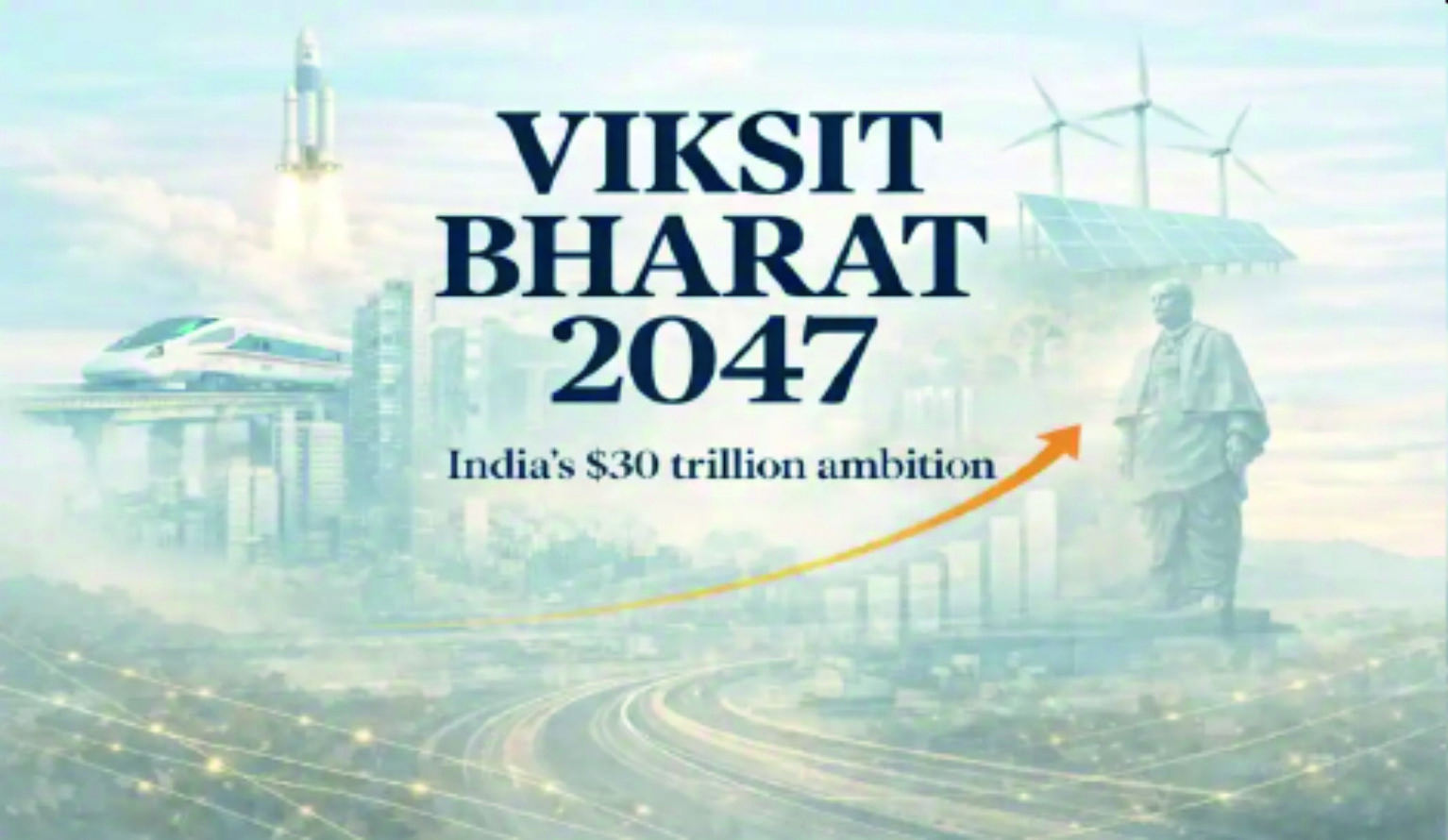
NITI Aayog’s Viksit Bharat 2047 vision targets a 30-trillion-dollar economy and 18,000-dollar per capita income by the centenary of independence. The mathematics require approximately 9.1 per cent real annual growth sustained over 21 years. The building blocks are genuinely present: a young demographic dividend (65 per cent of the population under 35), world-class digital infrastructure, an expanding manufacturing base under the PLI framework, a globally respected innovation ecosystem, and a strategic positioning as an alternative supply-chain partner to China for the world’s leading economies.
The path from vision to reality demands an honest confrontation with the unfinished agenda: reviving private investment through a credible regulatory compact, deepening net FDI quality, broadening the tax base, reskilling millions for the AI economy, reducing income concentration, and strengthening institutional quality and contract enforcement. India’s growth story is ultimately a story of extraordinary ambition meeting extraordinary complexity. The physical infrastructure is transformed. The digital architecture is world-class. The welfare floor has been raised for hundreds of millions. The geopolitical standing is the strongest in independent India’s history. The innovation ecosystem is vibrant and globally recognised. These achievements deserve recognition — not as partisan victories, but as national ones. The unfinished agenda — private investment revival, income equity, currency resilience, employment quality in the AI age — demands the same quality of policy resolve that delivered what has been completed. The Viksit Bharat 2047 goal is within reach. But it demands, above all, the courage of honest and balanced assessment.
CA Dr Dhanpat Ram Agarwal, Ph.D Economics, National Co-convenor, Swadeshi Jagran Manch and Principal Researcher & Founder Director, Institute of International Trade (IITrade), Kolkata
Key Sources: MoSPI National Accounts (2026) | IMF WEO April 2026 | RBI Bulletin May 2025 | World Inequality Database 2023 | NASSCOM FY26 Annual Report | EY India AI Impact Analysis 2025 | NITI Aayog Viksit Bharat 2047 (2024) | Ministry of Jal Shakti JJM Data 2026 | DPIIT Startup India Report 2025 | OECD FDI Report April 2025 | G20 India 2023 Presidency Outcomes | Bernstein Research April 2026