Nothing so great about free trade with Great Britain
India-UK FTA will increase our exports modestly but severely impact digital and climate sectors. — Jayant Dasgupta and Abhijit Das
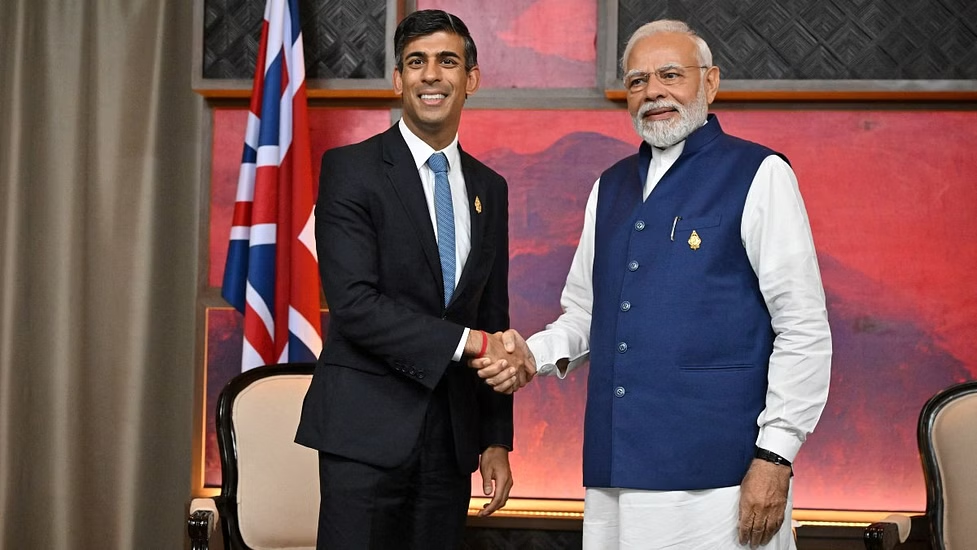
After the recent phone call between Prime Ministers Modi and Sunak, prospects for an India-UK free trade agreement appear to have brightened. It is likely to include commitments in traditional areas, such as trade in goods and services. It could also have provisions on issues that India has traditionally resisted in trade agreements – labour, environment, gender and intellectual property rights. Further, as India has taken commitments on digital trade and government procurement in its FTA with UAE, these issues are also likely to figure in the FTA with the UK. What could be the eventual impact of the India-UK FTA on India’s economy?
- On the trade front, we can expect a modest increase in India's exports of goods and services to the UK.
- With the UK's customs duties already low in most sectors, India's exports could make gains in just a few sectors, such as garments, leather products, gems and jewellery.
- We could also see some increase in India's exports of IT services.
On the other hand, India is unlikely to garner economic gains from provisions related to labour, environment, digital trade, IPRs etc. A study by the UK's department of international trade is sobering. Even in the most optimistic scenario, it predicts that the India-UK FTA could increase India's bilateral exports to the UK by £10.6 bn, and that of the UK by £16.7bn. As these increases are likely to happen gradually and only by 2035, hoping that the India-UK FTA would be a significant contributor to India's export growth appears misplaced. What about the costs for India of the FTA?
- Job losses appear inevitable in those sectors where imports from the UK would displace domestically. produced goods and services in India.
- This would arise from reduction/elimination of products. customs duties by India and opening of some services sectors, particularly financial services.
- Costs could also arise from FTA provisions that would curtail the ability of government to use policy instruments to boost the domestic production of goods and services.
Providing favourable treatment to Indian manufacturers and service suppliers in purchases by government is one of the limi- ted policy tools still available to govern- ment to boost domestic produ- cers. Having agreed in the India-UAE FTA to provide non-discriminatory treat- ment to UAE producers, In- dia would find it extremely difficult to resist similar demands from the UK.
It is also relevant to point out that despite the large size of govern ment procurement in the UK, a back of the envelope calculation suggests that less than £20 bn might be procured from sources outside the UK. Given the intense competition from other example. countries, including the EU and US, for this small pie, it is unlikely that Indian exporters will make any significant gains in the UK government procurement market.
- Let us turn to two sectors of huge economic potential for the future, digital sector and climate-friendly products.
- New products and technologies in both these sectors are likely to be created in the developed countries.
- If India does not want to become overwhelmingly dependent on imports, it would have to implement innovative policies for catching up with the first movers in these sectors.
- It is apprehended that the FTA could contain environment-related obligations that could hinder government's efforts aimed at transition to a low-carbon economy being driven predominantly by domestic players.
- And to appreciate the magnitude of economic gains that could be garnered by India through catch-up policies in the digital sector, consider that Rajeev Chandrasekhar, MoS in India's IT ministry, has been quoted as saying that data sets that represent India's consumers present "an estimated opportunity of more than $200-500 billion, if leveraged properly".
- It would be a huge economic cost to the nation, if FTA provisions constrain India from leveraging its data advantage.
In conclusion, a meagre increase in India's exports of £10.6 bn, that too spread over a decade, does not justify taking onerous commitments that could inflict multiple blows to the country's economic prospects. After all, India has not shied away from taking difficult. but correct, decisions on trade agreements in the past- walking away from RCEP negotiations being one such example.
For the sake of the country's robust economic future, a detailed and objective assessment of the likely economic benefits and costs of India-UK FTA is needed that Indian exporters especially of the provisions relating to labour, will make any significant environment, digital trade and IPRS - before moving forward in the negotiations.
Dasgupta is India's former ambassador to WTO. Das is an international trade expert. Views are personal.
Source: TOI