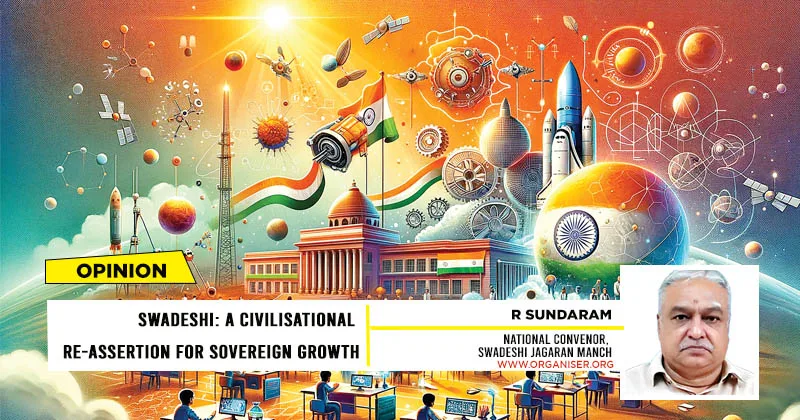
Swadeshi: A civilisational re-assertion for sovereign growth
The Swadeshi spirit has returned, not as nostalgia but as necessity. As global systems falter, Bharat looks within — to its people, its innovation, and its civilisational wisdom — for a model of growth that is sustainable, self-assured, and truly its own. — R. Sundaram
The entry of Swadeshi Jagaran Manch into Bharat’s economic discourse was not an isolated event. It emerged as a necessary response to a long history of imported ideologies, inconsistent policies, and the unfulfilled promise of equitable development. Our economic vision is contextualised against Bharat’s journey from state-directed socialism to market-driven liberalisation and onto an uncertain path of global integration. It is a philosophical rebuttal to paradigms imposed from outside, offering a worldview that is neither capitalistic nor socialistic, but uniquely Bharatiya – rooted in Bharat’s cultural and civilisational realities.
Lesson – From Dependency to Compromise
Bharat’s post-Independence economic model, shaped by the Nehruvian vision, was heavily influenced by Soviet-style development statism. While it built a foundational industrial base, it introduced the structural rigidities of the Licence Permit Raj, stifling entrepreneurship and innovation. Crucially, it failed to articulate an economic model genuinely born from Bharat’s own context.
The 1991 Liberalisation was a turning point, but one born of compulsion, not conviction. A severe balance of payments crisis forced the Government to devalue the rupee, dismantle industrial licensing, and to open to foreign trade and investment. These reforms, while necessary to avert crisis, were driven by IMF and World Bank conditionalities, marking a sharp departure from economic sovereignty. The simultaneous collapse of the USSR – which slashed Bharat’s rupee-based trade from 17 per cent to 2 per cent – delivered a double blow, exposing the perils of external over-dependence.
Globally, the formation of the World Trade Organisation (WTO) in 1995 reshaped trade rules to prioritise capital mobility and intellectual property rights, often at the expense of domestic developmental concerns.
In stark contrast, China pursued a state-controlled, strategic integration into the global economy. While Bharat and China had comparable GDPs (approximately $250 billion) in the early 1990s, China’s strategic approach allowed it to retain control, catapulting its share of global GDP to 18 per cent, while Bharat’s manufacturing base remained underdeveloped. The lesson is clear: Bharat failed to trigger an employment-intensive industrial revolution. The warnings of thinkers like Dattopant Thengadi Ji – against replacing one form of dependency with another, and Deendayal Upadhyaya Ji’s Integral Humanism cautioning against models divorced from our socio-cultural context – proved prescient.
Globalisation and New Consensus
For decades, the idea of globalisation held sway, and its critics were dismissed as backward-looking. The Swadeshi Jagaran Manch consistently cautioned against the financialisation of the economy on the US model, warning of manufacturing weakness and poor employment generation.
The 2008 Global Financial Crisis exposed the limits of finance-led development. COVID-19 pandemic then delivered a decisive blow, forcing every nation to look inwards. Global discussions shifted to de-globalisation, self-reliance, and localisation. Bharat’s response, the Atmanirbhar Bharat initiative, championing “Vocal for Local” and domestic supply chains, aligned perfectly with this new reality and the long-standing Swadeshi vision.
This shift has unleashed a wave of indigenous innovation:
- Digital Infrastructure: The success of UPI and the push for 5G
- Strategic Sectors: Boosts in defence production and a quantum jump in Khadi sales
- Innovation & Aspiration: Bharat becoming a global startup capital, the low-cost success of Chandrayaan, and the energy of its 40-crore-strong, highly aspirational Gen Z The mood of the nation has decisively shifted in favour of Swadeshi.
Swadeshi – A Data-Driven Imperative
Today, in the era of Trump tariffs and global turmoil, the urge for self-reliance is universal. We have learned the hard way. Swadeshi is not just an ideal; it is the pragmatic need of the hour, for ten compelling reasons:
- Demographic Imperative: With a population of 140 crore and a working-age cohort of approximately 100 crore, we face an unprecedented employment challenge. Our economic model must be fundamentally job-generating.
- Adequate Domestic Capital: Our Gross Domestic Savings are approximately 30 per cent of GDP, and household holdings of approximately 25,000 tons of gold (worth over $1.5 trillion) represent a vast, mobilisable resource. We are not a capital-scarce nation.
- Diminishing Returns from FDI: Net FDI is showing signs of moderation, and the transfer of core technology through these flows is often minimal. We must prioritise building our own technological capacity.
- A Technology-Powered Nation: Our human talent and educational standards position us to evolve as a technology leader. This requires a concerted increase in Research & Development expenditure and fostering a scientific mindset.
- Unfavourable Global Trade Environment: WTO projects global merchandise trade to grow at only 2.6 per cent in 2024. An export-led growth model is no longer a reliable primary strategy.
- Unparalleled Domestic Market: A Bharatiya middle class of over 70 crore people with substantial purchasing power creates an unprecedented opportunity for demand-led growth, which is why global capital is keen to access it.
- National Connectivity: Our extensive network of roads, railways, ports, and the deep penetration of broadband enable easy movement and communication. This facilitates de-urbanisation, allowing capital and jobs to move to where land and labour are available.
- Federal Growth Push: So-called ‘backward’ states are now pursuing ambitious growth targets, making the national dream of a $10 trillion economy a tangible possibility.
- Strategic Decoupling from China: Reducing the import of manufactured goods from China is an urgent economic and national security priority. Boosting domestic manufacturing strength is a wartime necessity.
- Future-Proofing Services: While our services exports have been strong, their scope may change. The focus must now expand to include hardware manufacturing to build a complete, sophisticated digital ecosystem.
A New Economic Model for a New Era
The year 2025 is not 1991. Our model must account for new realities, primarily that demography is destiny. Our unique generational diversity – with over 40 crore in Gen Z and Alpha – is like managing multiple nations within one. Maximising the utilisation of this human resource, spread across the country with diverse skills, requires a decentralised, micro-economic approach that is people-centric and locally tailored.
To ensure success, our approach must be guided by clarity:
- Swadeshi is not Autarky: We advocate for strategic interdependence, not isolation. We remain open to foreign trade and “sovereign-friendly FDI” that builds domestic capacity, not just market share.
- The Efficiency Imperative: Self-reliance must not protect inefficiency. Policy must foster fierce domestic competition, high-quality standards, and a superior ease of doing business to ensure Bharatiya products are globally competitive.
- A Balanced Ecosystem: Our world-class services sector is a national asset, not a weakness. The goal is a balanced economy where robust manufacturing complements our services leadership, fuelled by a shared digital infrastructure.
The imperative for Swadeshi is now a strategic and data-driven necessity. The experiences of the last 35 years have illuminated the perils of dependency and the power of our own market and people. By reclaiming our economic sovereignty, promoting a localised and ethical economy, and strategically engaging with the world, we can build a resilient, inclusive, and truly Atmanirbhar Bharat. The time for Swadeshi is now.