WTO and CDF
The WTO and CDF confirm that nothing is permanent. We believe in “One World - One Family - One Earth”. — Alok Singh
The World Trade Organization (WTO) and the China Development Forum (CDF) both face challenges in maintaining their relevance in today’s global landscape. While the WTO focuses on formulating and regulating trade policy, the CDF is centred around economic policy discussions specific to China. This distinction highlights a broader question: how the roles of trade and economic policy institutions evolve to meet the changing needs of a globalized world, where sound trade frameworks and national economic aspirations increasingly intersect.
Building on this distinction between trade and economic policy, it is useful to consider how economic policy generally allows for greater flexibility than trade policy. Institutions like the World Economic Forum exist, but they do not have the same mandate as the WTO.
Bharat has a commerce minister who participates in WTO conferences, and we also have a finance minister, but we don’t have any economics minister, and neither do many other countries. We have an Economic Advisory Council (EAC) and many other institutions to debate and discuss our economic and development policy. We do have institutions that interact and debate with the world to strengthen our economic policy. CDF is an exclusive, visible Chinese forum supporting China.
Understanding the interaction between institutional flexibility and narratives is crucial. The raise of narrative-driven leadership affects forums like the CDF. In a digital world, leaders prioritize image, complicating acceptance of criticism and reducing space for dissenting voices. This erosion of open dialogue blurs boundaries for constructive policy debate.
Amid these reputational and strategic challenges, both organizations’ histories shape their futures. China joined the WTO on 11 December 2001, and CDF was established in 2000. The WTO holds ministerial-level conferences around the globe, usually every two years, while CDF holds its annual meeting at a fixed venue in Beijing.
With this backdrop, it becomes clear that after a period of mutual benefit, both China and the WTO now face uncertain futures. However, the CDF can adapt quietly to changes and internal priorities, while the WTO’s global responsibility necessitates public consensus and strong international leadership. This distinction sharpens their respective strategic approaches to current challenges.
Both the CDF and the WTO appear to be in transition, as reflected in recent agendas and leadership changes. The CDF’s mission is to advance China’s interests in global discussions, whereas the WTO’s role is to set and enforce multilateral trade rules. How they each address these different objectives will highlight the evolving nature of international economic and trade governance.
One clear example of this institutional evolution is seen at their primary events—the CDF’s annual meeting and the WTO’s biennial conference—where global participation takes very different forms. The CDF controls its agenda and selects attendees to reinforce China’s priorities and its obvious. In contrast, the WTO includes all member states and seeks broad agreement, making for a more inclusive but complex process. These approaches reflect fundamental differences in their operational models.
Nevertheless, beyond these institutions’ event formats, economic and trade policymaking will continue. China’s economic policies predate the CDF, and international trade existed long before the establishment or rebranding of the WTO. These institutions shape policy but do not determine its absolute continuation.
Turning to the current landscape of trade frameworks, the world without the WTO is being practiced. The multilateral trade agreement, with a conscious decision-making process, is the core product the WTO offers. The WTO has no provision for voting on a decision. This has been compromised by another product. The WTO product line has added plurilateral agreements and it’s not obvious. The bilateral trade agreement is another product that the WTO technically cannot offer. The basic structure of the WTO is itself under existential threat.
The world trade has an alternative, and it’s being fruitful. Regional trade agreements are the most popular trade products these years. The lengthy trade negotiations and the short shelf life of such trade agreements reflect a behaviour similar to that of luxury apparel brands. The world will be more trade-friendly if it practices mass customization and quick delivery rather than the assembly-line model of standardized, mass production. The WTO is designed to behave like an assembly line, while bilateral trade agreements are designed like a high-end customized outfit.
The world without CDF is not even a topic to bother about. China has taken care of itself in whatever situations the rules of the world trade ecosystem dictated. The world has realized the relevance of multiple sourcing for goods and services. The CDF has realized that the world’s trade behaviour has changed. Hedging in goods and services can’t be achieved by a rule-based system like the status of Most Favoured Nation (MFN). MFN ensures that the country receives the lowest trade tariffs, minimal quota restrictions, and minimal trade barriers. The MFN status is the USP (unique selling point) of the WTO.
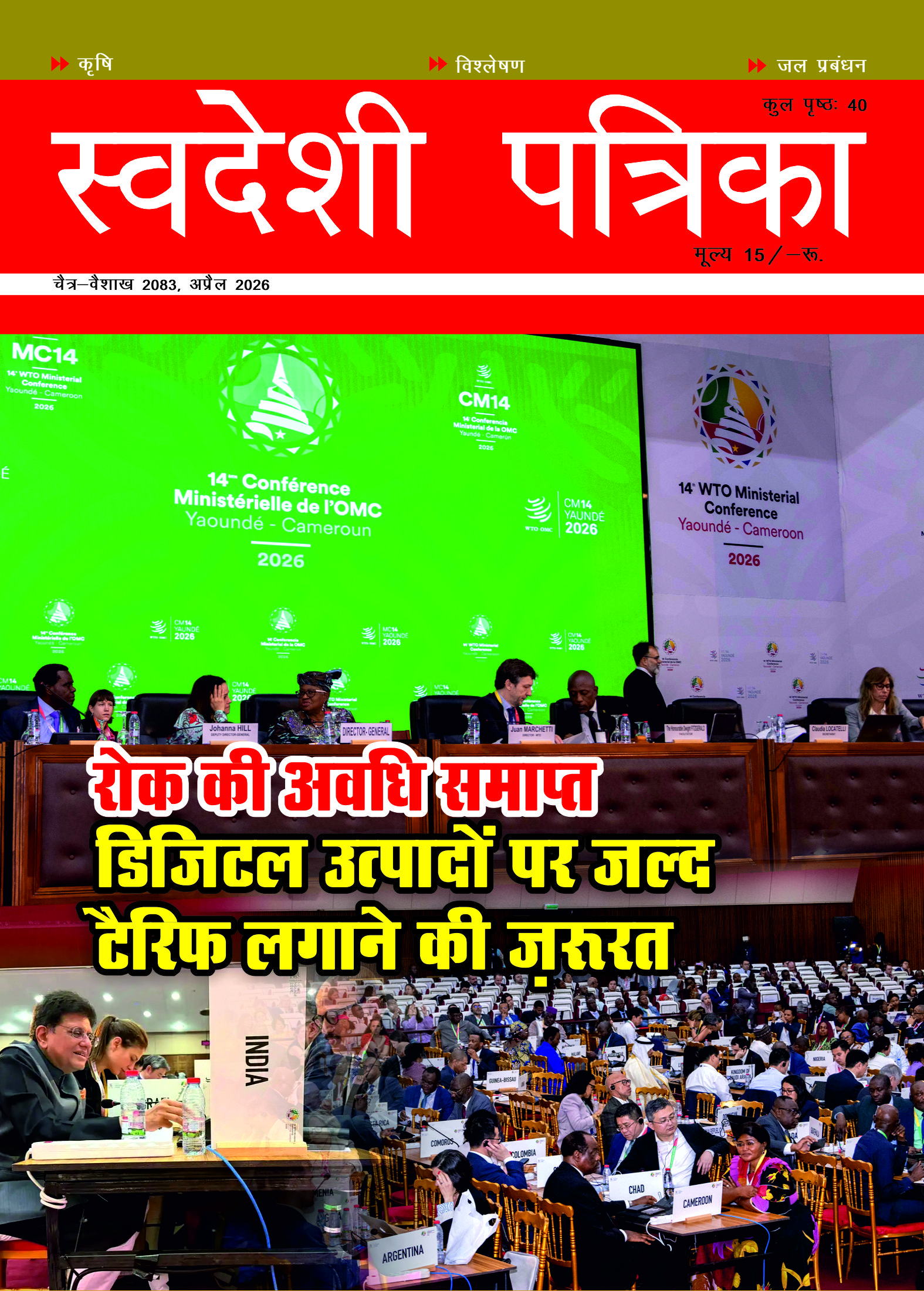
The fourteenth ministerial conference of the WTO, which was recently held in Cameroon, is being labelled the WTO’s nadir. It will also be remembered as a trade-off for a moratorium. So, a developed country will feel good about the expiry of the moratorium on TRIPS (Trade Related Aspects of Intellectual Property Rights), and a developing country will breathe a sigh of relief for the end of the moratorium on E-commerce.
Developed countries assume they are 50 years ahead of developing countries in technology-driven products, and developing countries are prospective buyers of technology. Hence, the end of the TRIPS moratorium is their gain. The dependence of developing countries on E-commerce is rising exponentially, and hence, the end of the moratorium on E-commerce will help fill the exchequer. It’s almost like - an eye for an eye, deal.
Bharat is transitioning through its demographic dividend. The WTO and CDF confirm that nothing is permanent. We believe in “One World - One Family - One Earth”. The immediate challenge is to skill our youths and safeguard the interests of our seven crore MSMEs (Micro, Small, Medium Enterprises), which support 30 crore livelihoods and contribute 30% to our GDP (Gross Domestic Product).
(Alok Singh has a doctorate in management from the Indian Institute of Management Indore and is a promoter of Transition Research Consultancy for Policy and Management.