The homecoming appeal itself is a reflection that our march towards the “Vikshit Bharat” is invincible. Our aspirations are unstoppable. Sridhar Ji is exploring all the routes to the holy destination. — Alok Singh
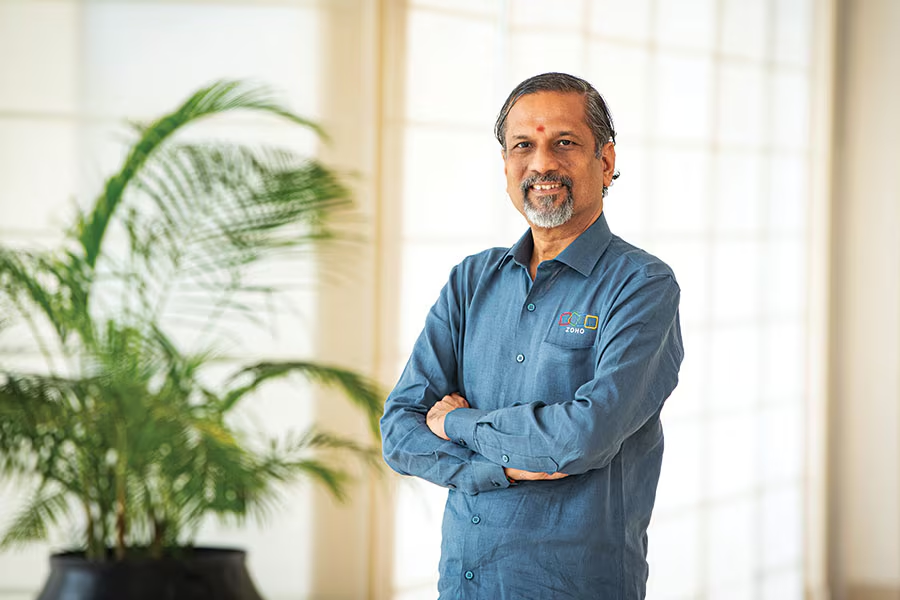
Padmashri Sridhar Vembu is a nationalist technocrat dedicated to uplifting rural Bharat and the nation for nearly four decades. The main argument of this piece is to analyse Vembu’s recent public appeal to Bharatiya talent abroad to return and contribute to the nation, examining its implications and the responses it has generated. As the founder of Zoho, Vembu embodies simplicity, vision, and a blend of scientific and social values.
Vembu is known for being accessible and for frequently sharing his opinions online, including his recent post on X, urging Bhartiya’s abroad to return home. This appeal ignited debates and responses reflecting on national soft versus hard power, the psychology of migration, and peer sharing of personal experiences. These responses reveal the complexity of persuading top talent to return and engage in nation-building efforts.
Our nation is young, and our aspirations are huge. The world is witnessing a transition in geopolitics, supply chains, value addition, technological breakthroughs, artificial intelligence, economic parameters, controlling stakes, warfare, education systems, and disruptive technological ecosystems. The world is divided between aging and young nations. Developed nations are more dependent on machines than humans. Our nation, with a working population of 60 crore, is desperate to engage this demographic productively.
Despite this, a missing link forced Sridhar Vembu ji to author a retreat appeal. Some see this as equivalent to begging. The trust in our youth’s capabilities is unstable. This stems from an old education system that produced many youths for repetitive work.
Zoho is well aware of the need for a timely supply of well-educated talent in mathematics, pure sciences, and engineering. Sridhar ji is restricting himself to that. Sridhar ji knows well the platinum mines that we own in the social sciences and soft power. But hard power has diluted the choices of even first-generation professionals working abroad. It’s the dollar that has trapped youths from premier institutions from working in sectors in which they aren’t trained, on taxpayers’ money that highly subsidized their education. For example, even civil engineers aspire to work in a software company.
The sectors well understood by Sridhar ji are information technology, information technology-enabled services, data centers, artificial intelligence, human aptitude, and the education system, apart from many other webs of the ecosystem.
Zoho has its own training school, and eligibility is not based on ornamental degrees but on aptitude and an individual’s learning curve. Zoho School produces its own software professionals, and the qualifications required to join are minimal. The perception is that even a 10th-grade individual can be trained at a Zoho school to join the world of software professionals.
An individual with a low learning curve could easily get trained to work in a software company. The majority of our software businesses, including exports, are in usage cases. The high-learning-curve jobs are the target of artificial intelligence. Until recently, it was easy for Zoho School to produce its own professionals. The learning curve is a metric for measuring learning proficiency. The learning curve portfolio includes low, high, S-shaped, and many other variants. A low learning curve means an individual can learn quickly, while a high learning curve means an individual can learn slowly. It’s the context that decides whether a low learning curve or a high learning curve is better. The S-shaped learning curve can be interpreted as fast learning at the beginning and slower learning later. There are various learning curves depending on the job. For example, a good doctor has a steep learning curve, while a good delivery boy has a shallow one. The learning curve is not determined solely by the amount of time spent learning, but also by other resources, such as the money and materials spent to help an individual learn the job.
The worldwide companies are feeling the heat of engagement with artificial intelligence. The traditional software companies are restricting their hiring processes. Geopolitics and an aging world, leading to diminishing demand, are creating constraints on the demand side. Aging China is emerging with dark factories. Dark factories are run without fans, room heaters , and thus without air conditioning and lighting.
The entry barrier for survival in the artificial intelligence sector is high. The learning curve is also high. This steep learning curve means the talent Bharat needs in a short time is difficult to find. This concern forced Sridhar ji to try the appeal to our best minds who are working for non-Bharatiya stakeholders. The Zoho founder is right and has done a responsible appeal.
The world, which is struggling to attract young talent, is opening research centres in Bharat. The Global Capability Centres (GCCs) of many companies, spread across various countries, are opening offices in Bharat. The profile of our quality of jobs has changed, and a clear transition is visible from being a supplier of use cases to a supplier of talent for research and development.
These developments create a dichotomy. On the one hand, we are appealing for the homecoming of our talents while, at the same time, deep-pocket foreign-owned companies are exploring avenues for their GCCs in our land.
The homecoming appeal itself is a reflection that our march towards the “Vikshit Bharat” is invincible. Our aspirations are unstoppable. Sridhar Ji is exploring all the routes to the holy destination.
We also aspire to think beyond artificial intelligence, which means what is next beyond artificial intelligence. At the culmination of the last century, it was computers and information technology; a quarter century later, it’s artificial intelligence. We have a portfolio of work in our hands, which includes catching up on disruptive technology, thinking and executing beyond the contemporary, and leveraging our soft power in infinite other ways.
We are not a nation of beggars, and neither is Sridhar ji. We are the primary source of universal peace and the original source of energy. We preserve ‘Astra’ (armaments) and ‘Shastra’ (knowledge) simultaneously.
(Alok Singh has a doctorate in management from the Indian Institute of Management Indore and promoter of Transition Research Consultancy for Policy and Management.)